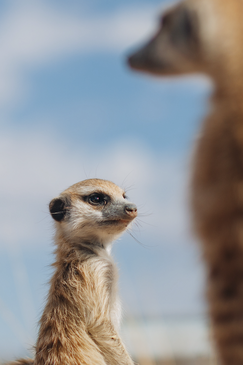
... in meerkats, at least.
Our new study has been published in Current Biology. (Click here for links to free PDFs of all my publications).
This study was unusual because I embarked on it expecting a negative finding. For several years, some researchers studying highly social mammals had been strongly suggesting that dominant individuals in animal societies had special delayed ageing rates. We've known for a long time that dominant individuals tend to live longer than their subordinate counterparts, but do they have slowed ageing? If they do - billions should be spent studying them to unlock the secrets of staving off inevitable age-related declines in health. But do they?
I suspected not. Slowed ageing rates that are somehow activated when an animal becomes dominant require some acrobatic physiology and evolutionary biology to explain. There is likely a simpler explanation. But with an open mind I set out to find out why dominants live longer, using the Kalahari Meerkats. For nearly two years we blood-sampled 35 meerkats repeatedly, to assess individual ageing rates. To do this, we analysed their blood telomeres, which are a genetic marker of cellular wear-and-tear that accumulates with ageing.
The data revealed that, as expected, dominant meerkats outlived subordinates. However, we found that dominants' ageing rates were not slowed, but accelerated, compared to subordinates. Reproduction and status defence was taking its toll on the dominants' cells.

So how do fast-ageing dominants outlive subordinates? We looked at other differences between these classes. For decades, scientists have followed the soap-opera dramas of meerkat day-to-day life. One frequent dramatic event is the disappearance of subordinates. Low-ranking females are violently kicked out of the group by the dominant female, and low-ranking males voluntarily trot off in search of mating opportunities, with both sexes usually returning after a few days. By contrast, dominants of both sexes never leave the group. We found that these trips away from the group were extremely dangerous, and solo subordinates were at risk of starving or feeding a nearby bird of prey. Dominants meanwhile enjoy the safety of the meerkat pack.
In short, dominants' lives aren't extended - subordinate lives are curtailed. Subordinates are not able to reproduce within their own group, so they are forced to leave the group and brave the dangerous Kalahari alone. Many do not survive. Those that do later become dominant themselves, and now have the good sense to never leave their group again.
As a reward for reading this far, why not have a look at my Lego Summary of the paper in this Twitter thread?